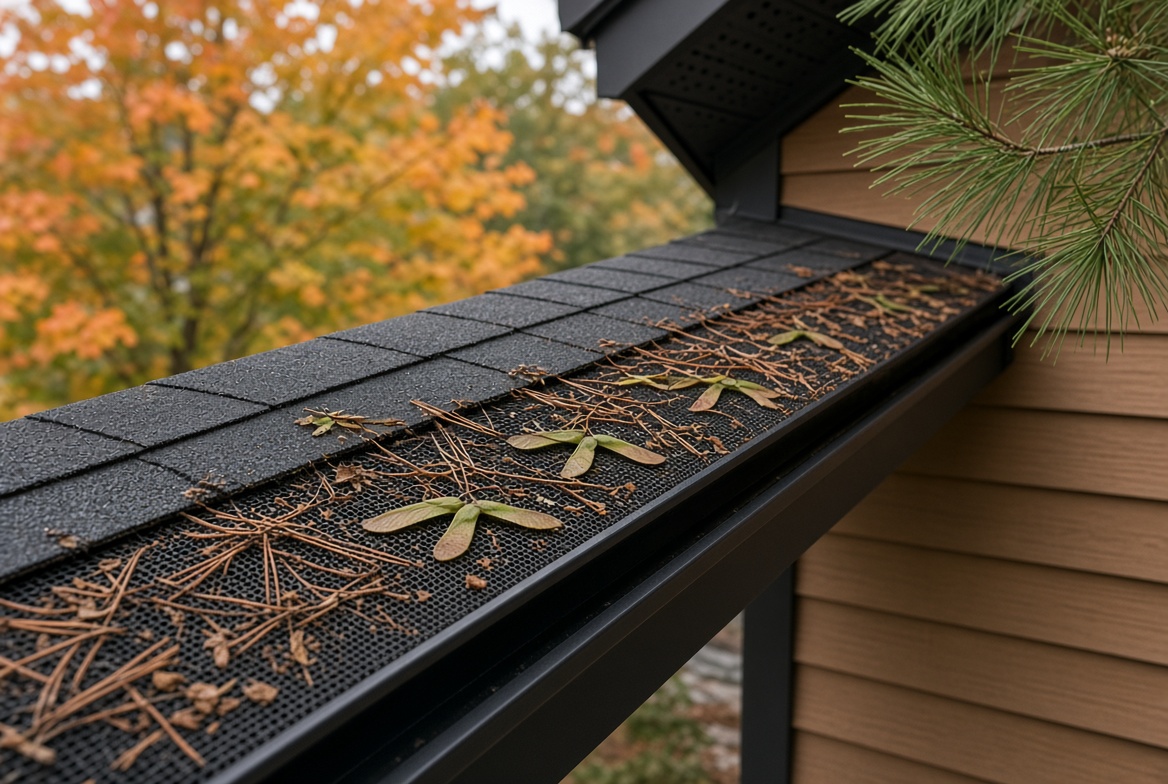
Best Gutter Guards for Pine Needles and Maple Keys in Ontario
Updated September 17, 2026. Infinity Gutters & Exteriors, Hamilton, Ontario.
Direct answer
The best gutter guards for pine needles are stainless steel micro-mesh systems with openings under 300 microns, small enough to block needles about a millimetre thick. They also stop maple keys. Every major warranty covers only clogs inside the gutter, so occasional brushing of the mesh surface remains the owner's job.
TL;DR
Micro-mesh under 300 microns is the only guard type that reliably blocks pine needles, which are about 1 mm thick
Maple keys hit Ontario gutters twice a year, late spring and fall, and can sprout in the trough
Reverse-curve guards let needles ride the water film into the inlet slot; screens mat over; brushes and foam trap debris
Manufacturer warranties cover clogs inside the gutter only; debris on top of the guard is the owner's job in the fine print
No guard prevents ice dams; attic insulation and ventilation do that, but a clear trough removes the trapped-water problem
Get the eavestrough assessed before covering it; guards lock in whatever condition sits underneath
One liner: Micro-mesh wins on Ontario's fine debris, as long as you read the warranty and keep the surface brushed.
Key numbers
What | Number | Source |
|---|---|---|
White pine needle thickness | 0.7 to 1 mm | Flora of North America description [1] |
White pine needle length | 6 to 13 cm | USDA Forest Service FEIS [2] |
Needle persistence on the tree | 2 to 3 years | Flora of North America description [1] |
Micro-mesh opening threshold | under 300 microns | hands-on testing of a 275 micron mesh [12] |
Maple key spring drop window | late spring, silver and red maple | MSU Extension [7] |
Warranty coverage scope | gutter interior only, in all three documents reviewed | manufacturer warranties [3][4][5] |
Ice dam cause and cure | roof heat loss; attic insulation and ventilation | NDSU Extension [11] |
The short answer
In short: micro-mesh under 300 microns wins; budget for surface brushing.
Stainless steel micro-mesh guards with openings under 300 microns are the best gutter guards for pine needles. White pine needles are about a millimetre thick [1], so they slip through or bridge every wider opening. Micro-mesh blocks them, though the mesh surface still needs occasional brushing.
The same mesh handles maple keys, the winged seeds Ontario maples drop in late spring and again in fall. Reverse-curve, screen, brush, and foam guards each fail against one debris type or the other. Some let it in, some wedge it, some trap it.
One caution before you buy. Every major manufacturer's warranty covers clogs inside the gutter, not the needle mat that can form on top of the guard [3]. The fine print gets its own section below, because it changes what "low maintenance" means.
Why pine needles and maple keys defeat most gutter guards
In short: needle geometry defeats openings; keys wedge and sprout.
Start with the needle itself. An eastern white pine needle runs 6 to 13 cm long and about a millimetre thick [1][2]. That shape is the whole problem. It's long enough to lie across wide openings and thin enough to slide through them point-first. Once a few needles catch, the rest weave into them, and you get a mat instead of a scatter. Water sheets over a soaked needle mat rather than draining through it.
Pines never take a year off, either. Each needle stays on the tree for two to three years and then drops [1], so a mature pine sheds a fresh load every fall no matter the weather. Spruce drops shorter, stiffer needles that run the same play at a smaller scale.
Maple keys play a different game. A key, properly called a samara, is a seed with a stiff wing. The wing hangs up on screens and troughs, and the seed end wedges into openings the way a doorstop wedges under a door. Silver and red maples drop keys in late spring, sugar maples from late summer into fall [7], so a maple-lined street hits your eavestroughs in two seasons, not one. Keys that settle into a damp gutter can even sprout there [7], and seedlings root into the debris layer and hold everything in place.
Picture the same Hamilton roofline in November. Unguarded, the trough holds a wet mat you scoop out by hand. Guarded with the wrong screen, the mat sits on top instead, needles threaded through every opening. Neither gutter drains. The guard type, not the guard, decides the outcome.
The five guard types compared
In short: four of five types admit or trap fine debris; micro-mesh alone keeps the trough clear.
The five common guard types split cleanly once you test them against fine debris. Micro-mesh uses openings under 300 microns, roughly the width of three human hairs side by side. Every other type works at a scale of millimetres or worse, and a millimetre is what a pine needle measures. Here's how each type handles Ontario's two problem debris classes, plus the column most comparisons skip: what you'll still be doing yourself.
Guard type | How it works | Vs pine needles | Vs maple keys | What still needs doing |
|---|---|---|---|---|
Micro-mesh | Fine stainless mesh over a frame; water passes through, debris stays on top | Blocked; needles dry on the surface and blow off or get brushed | Blocked; keys never reach the trough to sprout | Occasional surface brushing; rinse off sap and pollen film |
Reverse-curve | Solid hood; water follows the curved nose into a slot by surface tension | Needles ride the water film and collect in the slot [8][9] | Wings hang up on the nose and slot edge | Slot clearing; watch for overshoot in heavy rain |
Perforated screen | Metal or plastic sheet with millimetre-scale openings | Needles thread through point-first or weave into a surface mat [10] | Seed ends wedge into the perforations | Mat removal on top; scooping below once needles get in |
Brush insert | Bristle cylinder sits inside the trough | Needles lace into the bristles and stay caught [6] | Keys settle between bristles and can sprout | Pull every section, bang it out, clean the trough, reinstall [6] |
Foam insert | Open-cell wedge fills the trough | Fine debris packs the pores | Keys sit on top and root into the foam | Remove and replace the foam once it saturates [12] |
The pattern is hard to miss. Four of the five types either admit fine debris or become the thing you clean. Micro-mesh is the only design that keeps needles and keys out of the trough entirely, which is why it gets the full breakdown next. And this isn't marketing opinion. Patent filings for competing designs concede it plainly: needles ride the water film into reverse-curve slots and build dams on ordinary screens [8][9][10].
What the warranty fine print actually says
In short: coverage stops at the gutter interior; the mesh surface is yours.
Here's the correction that changes how you shop: gutter guard warranties cover clogs inside the gutter, and debris that collects on top of the guard is the owner's responsibility in the manufacturers' own terms [3][4][5]. That surface layer is exactly where pine needles test a guard, so the fine print matters more here than anywhere else.
Read the documents side by side and the pattern holds. LeafFilter's guarantee applies when the system lets debris clog the gutter and overflow, and its own footnote defines performance as preventing debris from "entering or clogging the gutter's interior" [3]. The LeafBlaster Pro warranty is blunter: "It is the owner(s) responsibility to unclog the mesh," and coverage is void when maintenance procedures aren't followed or sap builds up on the screen [4]. LeafTek's guarantee excludes failures caused by skipping "removal of debris lying on the top" of the product [5].
None of this makes the warranties worthless or the guards a bad buy. It means the brochure and the warranty describe two different products. The brochure describes a gutter you never touch. The warranty describes a system that keeps debris out of the trough while you, or your installer, keep the surface clear.
So before you sign anything, ask three questions:
Does the warranty cover debris on top of the guard, or only clogs inside the gutter?
What surface maintenance does the document require, and how often?
Who performs that maintenance, me or you?
A straight sales pitch for micro-mesh survives those questions easily. It turns gutter work from scooping wet mats into brushing a dry screen, and that's a real win. It's also why the installer who stands behind the system matters more than the logo on the mesh.
Micro mesh gutter guards: how the winning type works
In short: water passes through microns; debris dries on top and leaves.
Micro mesh gutter guards are fine stainless steel screens stretched over a rigid frame that sits across the top of the eavestrough. The openings measure a few hundred microns. The needle trying to get through measures about a thousand [1], so the math doesn't leave it much room. Water behaves differently at that scale: rain hits the mesh and surface tension draws it through into the trough below, while anything solid stays on top.
Follow one needle through a storm. It lands on the mesh, gets pinned flat by rain, and for an afternoon it looks like the guard has failed. Then the sun comes out. The needle dries where it lies, loses its grip, and the next decent wind carries it off the roof edge. That's the cycle a good micro-mesh system is built around: debris rests on the surface temporarily instead of entering the trough permanently. What the wind doesn't take, a soft brush does, which is the surface upkeep the warranty documents assign to the owner [3].
The mesh alone doesn't decide performance, though. The frame has to carry snow load without sagging, the fastening has to hold at the gutter and fascia without lifting shingles, since tucking a guard under the first shingle course can put a roof warranty at risk, and installers pitch the mesh close to the roof plane so debris slides instead of settling. Valleys and inside corners concentrate water and need particular care. Two houses with the same mesh can behave differently, and the difference is almost always the install.
Gutter guards for maple keys: the two season problem
In short: a two-season load; the guard that lets keys dry wins.
Most gutter guard advice is written for October. Gutter guards for maple keys have to work in May too, and that's the part standard guides skip. Silver and red maples release their keys in late spring, while sugar maples hold theirs until late summer and fall [7]. Norway maples, a common street tree in older Hamilton neighbourhoods, are among the heaviest samara producers of any maple [7]. Own a mix of species and your eavestroughs get loaded twice a year.
Keys also fail differently than needles. A needle's threat is penetration, slipping through openings. A key's threat is accumulation. The wing is too big to pass through most guards, so it stops at the surface, and the question becomes what happens next. On a screen, the seed end wedges into the perforations while the wing gets pinned under the next key that lands. In a brush, keys settle between bristles and stay damp. And a damp key doesn't rot politely, it sprouts [7]. Anyone who has pulled a row of maple seedlings out of a gutter in June knows how fast roots bind a debris layer together.
On micro-mesh, a key has nothing to wedge into. It lies on the surface, dries, and blows or brushes off, the same cycle needles follow. One roofline, two drop seasons, one behaviour that handles both. That's the standard a guard has to meet on a maple street.
What still needs cleaning, type by type
In short: every type keeps a task; micro-mesh keeps the smallest one.
"Maintenance-free" isn't on the menu. The real choice is between kinds of maintenance, so here's what each type leaves you on a lot with mature pines or maples overhead.
Guard type | Typical residual task | Rough cadence on a treed Ontario lot |
|---|---|---|
Micro-mesh | Brush or rinse the mesh surface, clear sap and pollen film | Once or twice a year, minutes per run |
Reverse-curve | Clear the inlet slot, wipe down the nose | Each drop season, plus a check after big storms |
Perforated screen | Lift the mat off the top, scoop what threaded through | Every drop season |
Brush insert | Remove sections, knock them out, clean the trough, reinstall [6] | Once or twice a year, a full removal each time |
Foam insert | Pull and rinse the foam, replace it once saturated | Yearly, with replacement every few years |
Treat those cadences as honest ranges, not promises. Two pines over the roofline ask more than one maple down the yard.
Watch for the same warning signs whatever you install: water sheeting over at valleys mid-storm, tea-coloured staining down the fascia, drips showing up behind the trough, and runs that sag or pull away from the house. A standing debris layer also invites nesting birds and insects, one more reason not to let it sit. Sagging means the hangers are giving, and that's repair territory rather than cleaning. The arithmetic still favours a good guard. Minutes with a soft brush twice a year beats an afternoon with a scoop every fall, and that's the trade you're actually buying.
Ontario factors: freeze-thaw, ice, and snow load
In short: guards fix trapped water, not ice dams; insulation fixes those.
Shopping for gutter guards in Ontario means asking winter questions the review sites rarely do. Start with the trough itself. A debris-filled eavestrough holds water, and standing water in a Hamilton November doesn't drain, it freezes. Repeated freeze-thaw cycling works ice into the seams, adds weight the hangers were never asked to carry, and by March you've got a sagging run and split joints. Keeping debris out of the trough is winter protection before it's anything else.
Be clear about what guards don't do, though. Ice dams form when heat escaping through the roof melts snow that refreezes at the cold eave, and the fix is attic insulation, air sealing, and ventilation, not anything you bolt onto a gutter [11]. Any guard sold as ice dam prevention is overreaching. What a guard actually removes is the trapped-water half of the problem: a clear trough gives meltwater somewhere to go on mild days instead of ponding on a needle mat and freezing after dark.
Snow itself is mostly a non-event for well-built systems. Quality mesh and frame carry a snow blanket fine when properly fastened, and LeafBlaster's warranty even notes that ice can form on the guard surface in extreme cold [4]. That's normal behaviour, not failure. What matters more is the trough underneath. If your eavestroughs are undersized, aging, or pulling away from the fascia, guards would be protecting a system that needs attention first, and new installation is the honest starting point.
Choosing and installing guards in Hamilton
In short: match guard behaviour to your trees, assess the trough first.
The decision path is shorter than the debate around it. First, walk your property and look up. Count the pines, note the maples, and check which ones sit over the roofline, because your debris load decides how much guard you need. Second, match that load to how a guard behaves, not to a brand name. Over pines or on a maple street, the comparison above points one way: micro-mesh, professionally fitted, with the surface brushing habit that comes with it. Lighter tree cover widens your options. Third, get the trough assessed before you cover it. A guard installed over undersized runs, tired hangers, or leaking seams locks those problems in.
That assessment is where to start with Infinity Gutters & Exteriors. A visit covers eavestrough condition, hanger spacing, valleys, and downspouts before any guard recommendation gets made, so you're protecting a system that's worth protecting. Bring the three warranty questions from earlier and put them to any installer you talk to, including us. Good answers should be easy to give.
One lesson to carry off this page: buy the behaviour, not the brochure. When you're ready to see what your roofline needs, request an assessment and quote for your Hamilton home.
FAQ
In short: quick answers to the questions Hamilton homeowners ask before installing guards.
Do gutter guards work for pine needles?
Only some types do. Stainless steel micro-mesh with openings under 300 microns blocks pine needles, which measure about a millimetre thick [1]. Screens, brushes, and foam admit or trap them, and reverse-curve guards let needles ride the water film into the inlet slot [8][9]. Type decides the result.
Will gutter guards keep out maple keys?
Most guards stop keys at the surface, since the wing is too wide to pass through. The difference is what happens next. Keys wedge into screens and settle into brushes, where they can sprout [7]. On micro-mesh they dry and blow or brush off, in spring and fall alike.
Do micro mesh gutter guards need cleaning?
Yes, occasionally. Manufacturer warranties assign debris on top of the guard to the owner and cover only clogs inside the gutter [3][4][5]. Expect to brush or rinse the mesh surface once or twice a year on a treed lot, which replaces scooping out the trough by hand.
Do gutter guards prevent ice dams?
No. Ice dams come from roof heat loss melting snow that refreezes at the cold eave, and the fix is attic insulation, air sealing, and ventilation [11]. Guards help winter differently: a clear trough drains on mild days instead of holding water that freezes, expands, and strains the seams.
Can I install gutter guards myself in Ontario?
You can with snap-in screens and brush inserts, and those are the types that struggle most with needles and keys. Micro-mesh rewards professional fitting, since pitch, fastening, valleys, and trough condition decide its performance. If your eavestroughs need repair first, cover that before covering them.
Definition bank
Term | Plain-English definition |
|---|---|
Micro-mesh | A fine stainless steel screen, with openings measured in microns, stretched over a frame that covers the gutter. |
Micron | One thousandth of a millimetre; a 300 micron opening is smaller than a pine needle is thick. |
Samara (maple key) | A maple seed with a stiff wing that spins as it falls. |
Reverse-curve guard | A solid hood that guides water around a curved nose into a narrow slot. |
Surface tension | The pull that makes water cling to a surface; guards use it to steer water. |
Perforated screen | A metal or plastic sheet with millimetre-scale holes laid over the gutter. |
Brush insert | A bristle cylinder that sits inside the trough and catches debris in its bristles. |
Foam insert | An open-cell foam wedge that fills the trough and lets water seep through. |
Ice dam | A ridge of ice at the roof edge that backs meltwater up under the shingles. |
Freeze-thaw cycle | Repeated freezing and melting that works water into seams and joints. |
Eavestrough | The Canadian term for the gutter trough that catches roof runoff. |
Fascia | The board along the roof edge that gutters fasten to. |
Sources
The Gymnosperm Database (Flora of North America description), Pinus strobus: needles 6 to 10 cm by 0.7 to 1 mm, persisting 2 to 3 years. Accessed September 2026.
USDA Forest Service, Fire Effects Information System: Pinus strobus, eastern white pine. Needle length 6 to 13 cm. Accessed September 2026.
LeafFilter, Manufacturer's Warranty. Accessed September 2026.
Gutter Guards International, LeafBlaster Pro 40 Year Limited Parts Warranty, PDF. 2022.
LeafTek, Warranty and Performance Guarantee. Accessed September 2026.
GutterBrush, Frequently Asked Questions About Gutter Guards. Accessed September 2026.
Michigan State University Extension, Maple seeds dropping in soon, 2012; Ask Extension question 847312 on sugar maple samara timing, 2023.
United States Patent RE42,896, Self cleaning gutter shield. USPTO.
United States Patent 6,536,165, Enclosed rain gutter. USPTO.
United States Patent 4,769,957, Needle and leaf drain gutter guard. USPTO.
North Dakota State University Extension, Reduce ice dam and icicle damage. January 2023.
This Old House, Best Gutter Guards for Pine Needles, hands-on testing. Updated December 2025.


